
How to do pursed-lip breathing when COPD makes you breathless
A slower out-breath through narrowed lips can ease the air hunger of COPD. The steps, how often to practise, positions that help, and when to call.
 Written byDr. Mohammad Fawzi Katranji
Published
Medical review pending. Awaiting review by Dr. Mohammad Fawzi Katranji.
Pursed-lip breathing is breathing out slowly through narrowed lips. It can ease the air hunger of COPD. It needs no equipment, and you can try it today.
Most people with COPD are told to do their breathing exercises and left to work out what that means. The steps, the positions, the pacing and the same-day threshold follow.
If your breathlessness is new, or worse than last week, book an appointment and have it looked at before you work on technique.
What the patient guidance and the trial evidence agree on:
- The out-breath is the half you can change, and slow air keeps the small airways open longer (American Lung Association).
- Practise while your breathing is comfortable, so the pattern is there before you need it.
- In a 2015 trial of 40 patients, nine gained more than 25% in endurance time, and the gain sat with low peak expiratory flow (HERO study record).
- Breathlessness the technique and your reliever do not ease needs a same-day call (controlled breathing discharge instructions).
What the slow out-breath does for trapped air
Pursed-lip breathing slows the air leaving your lungs. The American Lung Association puts the effect in one line: "This exercise reduces the number of breaths you take and keeps your airways open longer." Slower air gives the small airways less reason to close on the way out, so more of the trapped air can leave.
In COPD, air stays behind after you breathe out. The same guidance explains that stale air builds up over time, leaving less room for the diaphragm to contract and bring in fresh oxygen. The neck, back and chest muscles then take over the work.
It works on the feeling of breathlessness, while the disease in your lungs keeps its own treatment, with the inhalers and reviews your clinician prescribes.
How to do pursed-lip breathing, step by step
Sit down first, so the position does part of the work.
- Sit with your shoulders dropped, forearms on your thighs or the chair arms, jaw unclenched.
- Breathe in through your nose for about two seconds, a normal breath. A big one leaves no room to add more.
- Purse your lips as if about to whistle or blow out a candle.
- Breathe out slowly and gently for four or more seconds. MedlinePlus gives the count as four or more out against two in.
- Let your belly move, keep your shoulders still, and repeat until your breathing settles.
Most first attempts run into a mistake. Forcing the air out is the commonest of them, and fast air closes the airways you are trying to hold open. Breathing in too deeply stacks air on air that has not left yet, and hunching the shoulders gives the work to the muscles that tire first.
A round done well costs you less energy than it saves, which is how MedlinePlus describes the technique.
How often to practise, and for how long
Practise while your breathing is comfortable. The American Lung Association is blunt about the timing: "You don't want to first try these exercises when you're short of breath." MedlinePlus suggests four or five sessions a day, hooked onto things you already do.
A few minutes each time is enough, so that on a staircase your body reaches for a pattern it has already done.
After that, use it on demand, on effort or on an incline. A baseline spirometry test shows how much air you can move and how fast, which is how your clinician judges whether a change is new. Without one, the comparison is guesswork.
Positions that help, and the ones that work against you
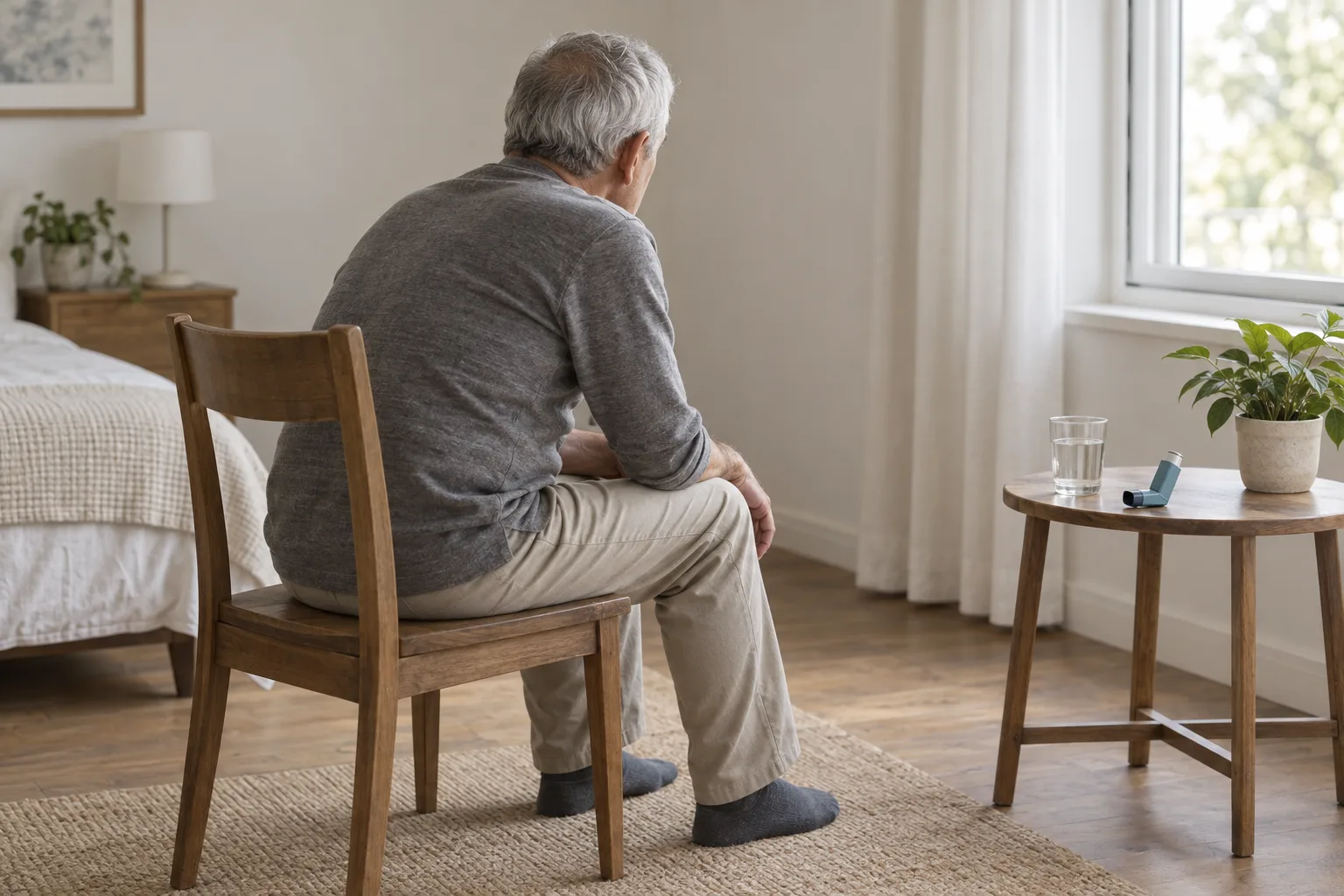
Where your arms rest decides how much room the diaphragm has. Cambridge University Hospitals' leaflet on positions to ease breathlessness explains that these positions put the breathing muscles in a better place to help, and that leaning forward may improve the movement of the diaphragm.
Learn the forward lean first: feet flat, legs comfortably apart, forearms on a table or on your thighs. Standing, it works against a wall, a kitchen counter or a shopping trolley.
The leaflet also lists supported side lying, fully over on your side with the upper arm and leg on a pillow, and propped upright in bed with pillows under the arms and shoulders. Too many pillows under the arms push the shoulders up, which undoes the point.
Slumping into a soft chair and lying flat on your back do the opposite, and both are easy to change.
Pacing a walk or a flight of stairs
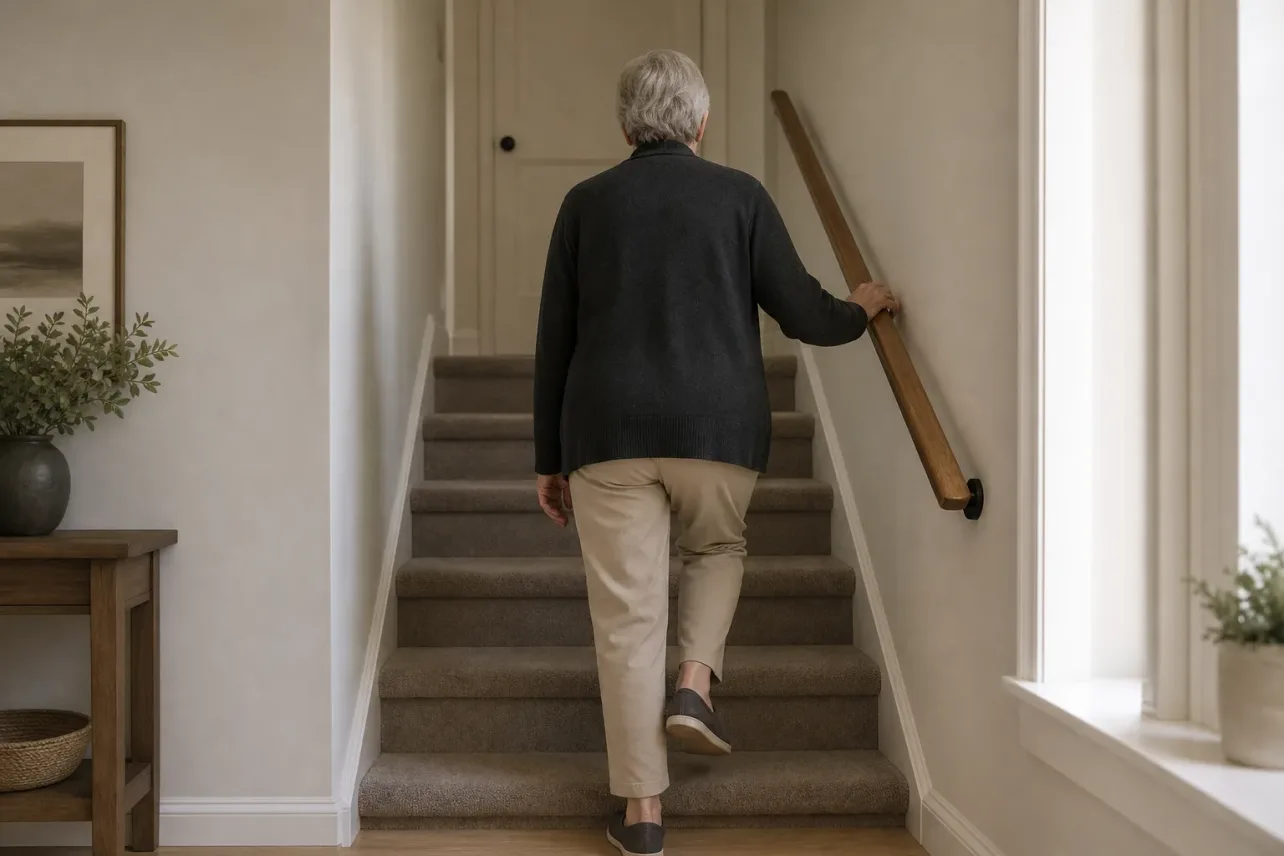
On your feet, the count gets a beat: in for two steps, out through pursed lips for four or more, the ratio MedlinePlus gives in seconds. For a slope, keep the ratio and shorten the steps.
When you climb stairs, breathe out as you step up. Blowing out on the push is easier than holding your breath through it. Stop on the landing while you can still talk.
Lifting, pushing a heavy door and getting out of a low chair take the same treatment. The same leaflet notes that a four-wheeled walker gives you a portable leaning post to stop against, and that some have a seat.
When panic arrives with the breathlessness
Breathlessness and alarm travel together. The breath goes shallow and fast. Shallow breathing sharpens the air hunger, and the alarm climbs again.
These moves help while it is happening, and none needs equipment.
- Stop and sit forward, forearms supported.
- Lengthen only the out-breath.
- Name one thing you can see, one you can hear, one you can feel.
- Use your reliever inhaler as prescribed.
They steady the breathing without treating what is causing it, and they do not replace the reliever or a review. For some people the panic settles; for others it comes back the same day, and that pattern is worth describing to your clinician.
What it can and cannot do
The evidence is more modest than most descriptions suggest. In a 2015 randomised crossover trial of 40 patients with stable COPD, nine increased their endurance time by more than 25% when breathing through pursed lips.
The trial's conclusion narrows it further: the benefit appeared in patients with low peak expiratory flow, and during exercise below peak effort. The patients were aged 40 to 75 with lung function already reduced, so a reader with milder obstruction sits outside the group studied.
That leaves the technique worth trying, with modest expectations. It will not stand in for prescribed inhalers or a pulmonary rehabilitation programme, and if it does nothing for you that is information rather than failure.
COPD care and how it is planned starts from what your lungs are doing now. Pulmonology care in Dubai covers assessment in person or by video, and you can ask for one without a referral.
When a technique is not enough
The threshold is the part to remember. If breathlessness is not eased by the breathing exercise or by your reliever inhaler, that is a same-day call, according to controlled breathing discharge instructions for COPD.
The same urgency applies to chest pain, blue lips, confusion or unusual drowsiness, a fever with worse breathlessness, and coughing up blood. In the UAE, call 998.
The article on COPD flare-up warning signs sets out what a flare-up looks like and what to do in the first hours. Outside the UAE, a video consultation can cover the assessment when symptoms allow it.
Pick one practice slot a day you will keep, then try the technique once on the stairs. If your breathlessness is new, worse than last week, or not eased by anything you try, book an appointment and have it assessed.
References
- American Lung Association. Breathing exercises for better lung health.
- MedlinePlus. How to breathe when you are short of breath.
- Cabral LF et al. Pursed lip breathing improves exercise tolerance in COPD: a randomized crossover study. Eur J Phys Rehabil Med, 2015. HERO study record.
- Cambridge University Hospitals NHS Foundation Trust. Leaflet 4: Positions to ease breathlessness.
- Controlled breathing for COPD: discharge instructions.
Medical information. This article is educational and does not replace individual medical advice. In an emergency call 998.