
COPD Exacerbation: Warning Signs and When to Get Help
Breathlessness, cough or phlegm worse than usual and lasting two days or more: how to tell a flare-up from a bad day, and when to call 998 in the UAE.
 Written byDr. Mohammad Fawzi Katranji
Published
Medical review pending. The reviewer for this page is Dr. Mohammad Fawzi Katranji, consultant pulmonologist, who holds four American Board certifications and has worked in the UAE since 2014. The page carries the practice's pending label until he signs it, and the review date will sit here when he does.
A COPD flare-up means your breathlessness, cough or phlegm is worse than your own normal, and has stayed that way into a second day. Doctors call this a COPD exacerbation, and it needs attention the same day. A routine review three weeks from now is too late for it.
How a flare-up goes depends on how quickly you notice the change and how fast you act on it. Both can be learned, starting with what to track, then the first 48 hours, then the signs that mean calling 998.
This page is for people who already have a COPD diagnosis, and for the family member watching their breathing at night.
- A flare-up is a change in breathlessness, cough or phlegm that holds for two days or longer and is sharper than your usual symptoms, as MedlinePlus defines one.
- Symptoms that are not better after 48 hours are a reason to contact the clinic or go to hospital, as MedlinePlus advises.
- Sleepiness or confusion during a flare-up is an emergency sign; in the UAE, call 998 for an ambulance.
- Most patients discharged after a flare-up that needed hospital care still had not returned to how they felt 90 days later, though clinical definitions expect recovery in about two weeks, according to AJMC's account of the 2025 CHEST interviews.
- A change in phlegm colour points towards infection, and a clinician looks for it alongside a rise in sputum volume or in breathlessness before treating with antibiotics.
What a COPD exacerbation is
The word exacerbation means the same thing as flare-up. NICE's COPD guideline defines it as a sustained worsening of your usual stable symptoms, beyond normal day-to-day variation, and acute in onset. It lists worsening breathlessness, cough, more sputum and a change in sputum colour among the symptoms people report most. The patient version is easier to act on: MedlinePlus describes a flare-up as increased signs and symptoms lasting 2 days or more, and sharper than your usual ones.
A bad day passes. You wake more breathless than yesterday, take your reliever, and by the afternoon feel like your ordinary self again. A flare-up holds on: the change is still there on the second day, and often on the third.
That is why your own baseline counts for more than any general range. Your baseline is what an ordinary week feels like: how far you get on a flat walk without pausing, how many flights of stairs you manage, whether you cough when you get up. With spirometry from a stable week on file, a change can be judged against your own figures, and an inhaler technique check shows whether the medicine reaches your lungs at all.
If you cannot tell whether this is a bad day or the start of a flare-up, book an appointment and describe what changed and when it began.
The changes worth tracking
Breathlessness, cough and phlegm carry most of the signal, and each one is measured against your own normal.
| Change | What to compare it with | What to note down |
|---|---|---|
| Breathlessness | What you can usually do without stopping, such as walking to the car or climbing one flight of stairs | The date it started, and whether it now stops you mid-sentence or at rest |
| Cough | How often you cough on a normal day, and whether it wakes you at night | Whether the cough is new, more frequent, or bringing up something it did not before |
| Phlegm | How much you usually bring up in a morning, and its usual colour | More volume, a thicker texture, or a colour that has moved from clear or white towards yellow, green or brown |
A change in colour is a pointer towards infection. It does not prove one, and it is not a reason to start a leftover antibiotic from an earlier course. Antibiotics are kept for flare-ups a clinician judges bacterial, where purulent sputum comes with a rise in sputum volume or in breathlessness, as BMJ Best Practice notes.
Wheeze and a cough that wakes you at night belong to asthma as much as to COPD, and the two conditions can coexist. If you have never been sure which one you are dealing with, how COPD differs from asthma sets out the tests that separate them.
Why COPD is worse some days
Airway inflammation in COPD already runs on a shifting baseline, and a trigger on top of it shows up as a worse day. A cold or another viral infection is one of the usual ones, and so is a bacterial chest infection. A flare-up can follow an infection without one being proven at the time, which is why what you describe matters more than a guess at the cause.
Dust and smoke come next. In the UAE that can mean a hazy, dusty day, tobacco or incense smoke indoors, traffic fumes on a long commute, or cold air from an air-conditioning vent across the bed at night. Missed doses of a controller inhaler belong on the same list, since that medicine works only while it is taken on schedule.
Weather and humidity change how the air feels to breathe, and some people notice trouble in the shoulder months more than in high summer. A change that follows a specific exposure, such as a dusty week, a house move or a new commute, belongs in the consultation, because it points at a trigger that can be reduced.
Not every flare-up is an infection. A clinician assessing a worsening will also weigh other causes of breathlessness that can look similar: pneumonia, a clot in the lung, heart failure, or a rhythm problem. That is the reason a change which does not settle is worth assessing instead of watching at home for another week. COPD sits among the other lung conditions we treat, and repeated flare-ups are a reason to review prevention rather than accept them as the shape of the disease.
What to do in the first 48 hours
Start on the day the change appears, while you can still describe what has changed. Where a written flare-up plan exists, follow it over anything on this page.
- Contact the clinic the same day. A call on the day the change starts gives you a plan while you are still well enough to describe it. If the clinic may be closed, ask about the out-of-hours route now, and keep that number where the family can find it.
- Use your reliever inhaler exactly as your plan says. A reliever needed far more often than usual is information for the clinician, so note the count and the times. Doubling the dose on your own takes away the clearest measure of how you are doing.
- Follow any rescue plan already agreed with Dr. Katranji. If a course of steroid tablets was written into your plan for this situation, follow the written instructions and the dates on them.
- Keep your regular inhalers unchanged. Stopping or altering a controller inhaler during a flare-up is the mistake people make at this step. The decision belongs to a clinician who knows the rest of your history.
- Act on the 48-hour mark. If symptoms are not better within 48 hours, or they keep getting worse, contact the clinic or go to hospital, which is the advice MedlinePlus gives.
Done looks like a same-day reply with a written plan: what to take, at what dose, for how many days, and whom to call if the evening brings worse breathlessness. Photograph the page, because a relative may be acting on it at two in the morning.
When to get emergency help
For some signs an ambulance is the right call, and waiting for the clinic is too slow. In the UAE, the ambulance number is 998, as the practice's COPD, its tests and how care is planned page sets out. Say that the person has COPD and is in a flare-up, because the crew will ask about breathing and about how alert the person is.
- Breathlessness at rest, or breathlessness that stops you speaking in full sentences.
- Drowsiness, confusion, or a family member finding you hard to rouse. MedlinePlus lists sleepiness and confusion among the signs that mean calling for help.
- Lips or fingertips that look blue or grey.
- A reliever inhaler that brings no relief.
- Chest pain, or coughing up blood.
Read the list once now, while nothing is happening, so that the person who watches your breathing knows it too.
On the call, say that this is COPD and that breathing is the problem, then give the age, the address and the nearest landmark. Keep the medicine list beside you, since the reliever count and any steroid course are details the crew will ask for. Unlock the door, put a light on, and tell the building reception that an ambulance is coming.
Do not wait for a scheduled review, and do not drive yourself to the emergency department if you are the person who is breathless. A family member driving someone who is drowsy or confused is the wrong arrangement, so call 998 and stay with the person until the crew arrives.
How long a flare-up lasts
Clinical definitions expect most people to recover from a flare-up within about two weeks. The patients interviewed in 2025 reported something different: most had not reached their own definition of recovery 90 days after discharge, according to AJMC's report of the CHEST interviews.
The published benchmark is about two weeks, then, and a fair number of people are still not back to their own normal at three months. That gap matters for planning: a return to work, a flight or a family visit is better booked with the longer figure in mind.
Report a slow recovery instead of accepting it. Ask at the follow-up what the spirometry shows now against your stable baseline, and whether anything in the plan should change. A flare-up that leaves you more breathless than before is also a reason to have your inhaler technique and your maintenance treatment reviewed, so book that review now.
After a flare-up that put you in hospital, the follow-up has several things to check: the medicines you came home on against the ones you took before, whether the inhalers still suit your hands and your breath, vaccination status, and whether a course of pulmonary rehabilitation would help. Ask when that review should happen, rather than waiting for the next scheduled appointment to raise it.
Recovery involves more than the lungs. A spell of breathlessness costs muscle strength and confidence, which is why the rehabilitation question is worth asking once the breathing has settled.
Preventing the next one
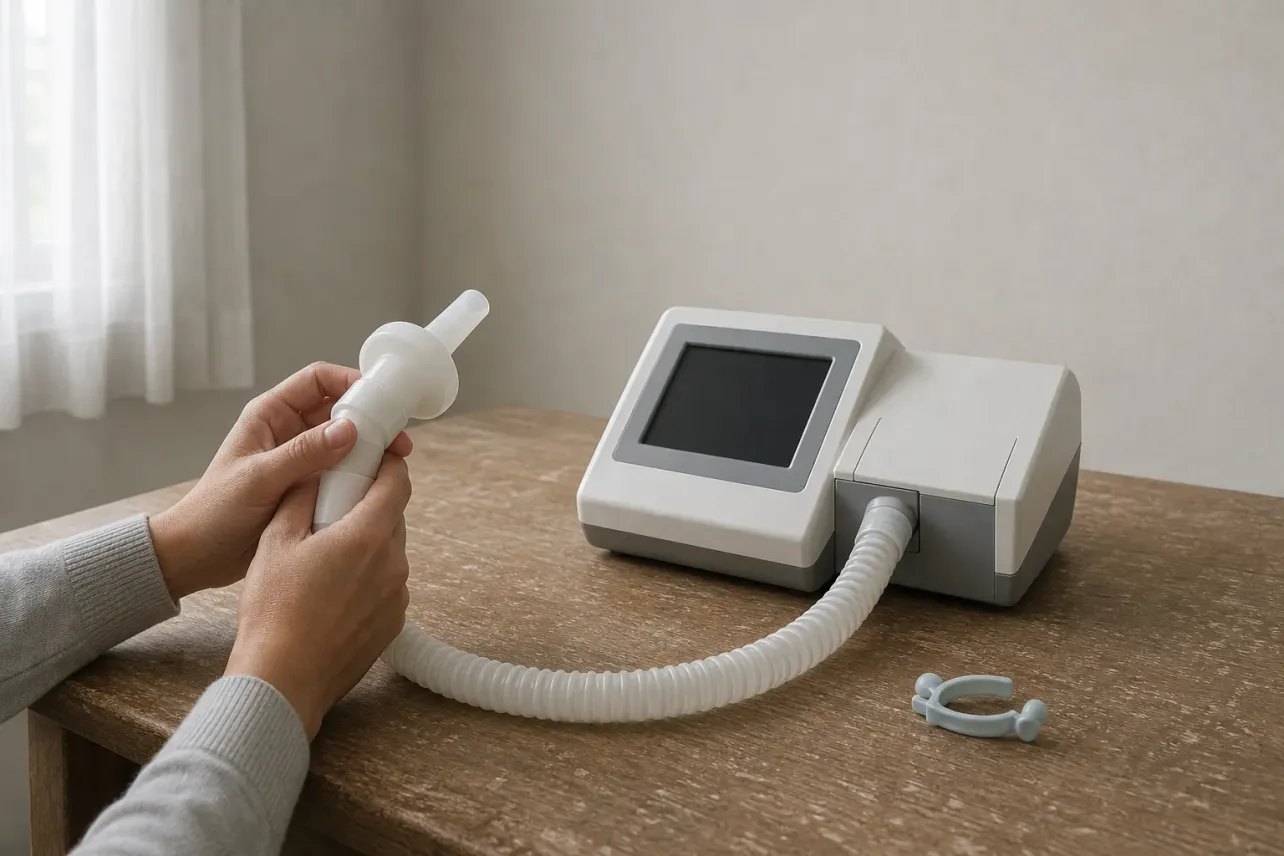
Most of what reduces the next flare-up is already part of routine COPD care.
Inhaler technique comes first. The NICE guideline on COPD care asks for it to be checked at regular intervals, and corrected where it is wrong, by a professional competent to make that check. A device that suited you five years ago may not suit your hands now, so bring your inhalers to an appointment and use them in front of the clinician.
Vaccination comes next: the same guideline advises pneumococcal and annual flu vaccination for everyone with COPD. Ask at the clinic which ones you have had, and when the next is due.
Smoke and dust are the part you control. Smoking is the exposure worth stopping, and help to stop belongs in routine care. A dusty day is a reason to keep the windows shut and stay indoors during the worst hours.
Last, know where your lung function sits. Spirometry taken before you use a bronchodilator and again afterwards gives the number against which a future change is judged. What spirometry measures explains the test, and the tests we run lists it with the rest of the diagnostic service.
NICE puts frequent flare-ups at four or more a year with sputum, and that pattern is what prompts a specialist review of prevention. If that has been your year, it is worth a consultation.
Questions about COPD flare-ups
What is a COPD episode?
A COPD episode is the same thing as a flare-up or an exacerbation: breathlessness, cough or phlegm that is worse than usual for you and lasts more than a day or two. Doctors use all three words for it, and the change is judged against your own normal.
Why is COPD worse some days than others?
Breathlessness in COPD varies with infections, dust, smoke, cold air, humidity and missed inhaler doses, so a worse day usually has a cause. A change that lasts two days or more, or comes with more phlegm or a new colour, is the pattern to report.
Can COPD cause chest infections?
Yes. An infection is one of the usual triggers of a flare-up, and a flare-up can leave the airways more open to one. A change in phlegm colour points towards infection without proving one, so the decision about antibiotics belongs to a clinician who can assess you.
What can I do to help with COPD?
The routine steps are stopping smoking, taking controller inhalers as prescribed, having inhaler technique checked in person, keeping flu and pneumococcal vaccination up to date, and reporting a flare-up early. Spirometry at intervals shows whether any of it is holding.
What to do next
Before the next flare-up, find your written plan, or ask the clinic for one, and check that the people you live with know where it is and what 998 is for. Then look at your reliever: if nobody has watched you use it in years, that is the appointment to book.
This month, take the plan to a review and ask what your spirometry showed at your best, and what your inhaler technique looks like now. Those answers turn a vague sense of being worse into something a clinician can act on.
Watch for the change that lasts into a second day. That is the point to call, and the point where the call is easiest.
If you would rather have that conversation in person or by video, book an appointment and bring the plan with you.
Medical information. This article is educational and does not replace individual medical advice. In an emergency call 998.