
Chronic bronchitis and how it differs from COPD
A productive cough that has gone on for years already meets a clinical definition. What chronic bronchitis does to the airways, why a lung test comes next, and where it parts from COPD.
 Written byDr. Mohammad Fawzi Katranji
Published

If you bring up phlegm most mornings and have done so for two years running, the pattern may already meet the definition of chronic bronchitis: a productive cough on most days for three months in each of two consecutive years. The definition is clinical, so it rests on your history.
Smoking is the main cause behind that pattern, as the NHS puts it, and long-term exposure to harmful fumes or dust explains some cases. Spirometry is what shows whether airflow limitation has already developed.
Key takeaways
- Chronic bronchitis is defined by a pattern: a cough with phlegm on most days, three months a year, in two consecutive years. The Medical Research Council definition also requires other causes, such as bronchiectasis and tuberculosis, to be excluded first.
- Smoke makes the airway lining swell and stops the cilia clearing mucus, so phlegm collects and has to be coughed up. Cigarettes, shisha and workplace dust all act this way.
- The NHS groups chronic bronchitis under COPD, yet COPD is defined by airflow limitation on a breathing test. Some people with chronic bronchitis have normal airflow.
- NICE advises considering spirometry in chronic bronchitis, because a significant proportion of people go on to develop airflow limitation.
- Yellow or green phlegm does not prove an infection, and antibiotics do not treat chronic bronchitis itself.
What chronic bronchitis means
Chronic bronchitis is long-term inflammation of the airways that causes a cough bringing up phlegm on most days, for at least three months a year, in two years running.
The threshold is old and still in use, and the CDC's archived account of the Medical Research Council definition keeps the half that people forget: other causes of a productive cough, such as bronchiectasis and tuberculosis, must be excluded first. The same account notes that many people with early chronic bronchitis have a cough and sputum for fewer than three months each year, so they fall below the line while their airways are already changing.
Chronic bronchitis sits with the other lung and airway conditions assessed at a respiratory clinic. If the morning phlegm has been there for years, book an appointment and describe the pattern. No referral is needed.
Symptoms: how the cough behaves over the years
The usual story is phlegm that comes up most mornings, with a cough that eases as the day goes on. Many people call it a smoker's cough, and the NHS notes that this is how a persistent chesty cough with phlegm is dismissed. Over the years it tends to start earlier in the day and take longer to clear.
Wheeze and chest tightness often come with it. Breathlessness appears first on stairs, hills or a brisk walk, then on smaller efforts. Some people notice a run of chest infections each winter more than a daily cough.
A cough that brings up nothing is a different problem. A cough with no phlegm has its own list of causes, from reflux to asthma to medicines.
Coughing blood, breathlessness at rest or breathlessness that wakes you from sleep, a fever alongside worse breathlessness, or lips and nail beds turning blue all need same-day assessment. In the UAE, call 998 for an emergency.
What damages the airway lining: smoking, shisha and dust
Smoke acts on the airway lining in two ways at once. It makes the lining swell and the mucus glands enlarge, so more mucus is produced, and it stops the cilia, the fine hairs that sweep mucus upward, from clearing it. Mucus then collects, and coughing becomes the only way left to move it.
Cigarette smoke is the main cause, and the form it is taken in makes little difference, since shisha and waterpipe tobacco send the same smoke into the same airways. Workplace dust, chemical fumes and regular exposure to smoke in enclosed spaces do similar damage. People who have never smoked can still develop the condition, which is why the history covers your job as well as your cigarettes.
For anyone who smokes, stopping is the step that matters most. The damage already done is permanent, and treatment can help slow the progression.
How chronic bronchitis differs from COPD
The two terms are used almost interchangeably. Chronic bronchitis is described by symptoms, and COPD is defined by a breathing test.
| Feature | Chronic bronchitis | COPD |
|---|---|---|
| What it describes | A symptom pattern: phlegm coughed up on most days, judged over years | A lung function diagnosis: airflow limitation that does not fully reverse |
| Main symptom | A productive cough, usually worst in the morning | Breathlessness on effort, often with cough and phlegm |
| What spirometry shows | Normal airflow, or obstruction that has already developed | Obstruction that persists after a bronchodilator |
| What helps | Stopping smoking, clearing mucus, treating infections early | Stopping smoking, inhalers, pulmonary rehabilitation, a flare-up plan |
The two overlap because the same smoke drives both, and plenty of people have both at once. The NHS lists chronic bronchitis among the conditions included in COPD, so the label can be used for someone whose main problem is a daily productive cough.
The next step is what changes how you act on it. NICE advises considering spirometry in people with chronic bronchitis, because a significant proportion of them go on to develop airflow limitation. A normal breathing test at one visit describes that day only, so if the cough continues the question is worth reopening. For the care side, read how COPD is assessed and what a long-term plan holds.
When the phlegm changes colour
Phlegm that turns thicker and yellow or green usually means more inflammation in the airways, and an infection on top of chronic bronchitis is one cause. Health advice from Nova Scotia Health describes the mucus in such an infection as possibly yellow or dark green. Colour alone does not settle whether bacteria are involved, because a viral illness can produce the same shade.
Antibiotics have no effect on chronic bronchitis itself, as that same guidance puts it, and they are weighed only when a lung infection is present on top of it. The NHS makes a matching point about ordinary bronchitis: antibiotics may be offered when a more serious infection is behind it.
Fever, a clear jump in breathlessness, more phlegm than usual and a sense of being more unwell all carry more weight than colour does. When sputum stays purulent and keeps coming, NICE recommends culturing it to identify which organism is there.
The other question is whether this is ordinary bronchitis at all. Ordinary bronchitis usually gets better without treatment in about three weeks, and a cough that behaves that way each winter is a different problem from one that never fully goes.
What a first appointment tests
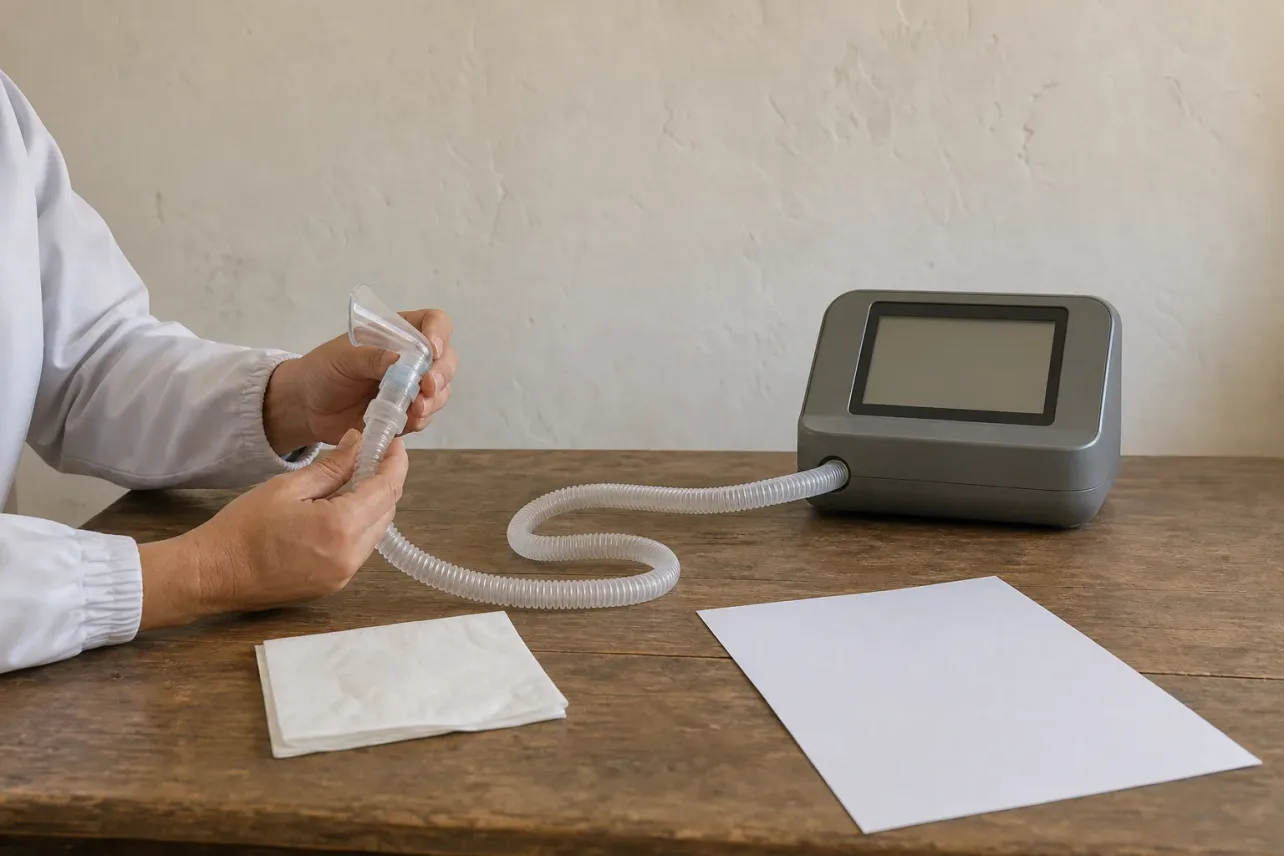
A specialist assessment begins with the pattern, and the pattern is mostly a set of questions.
- The history. How long the cough has been there, how many months a year it lasts, what you bring up, whether you smoke or have smoked, any shisha or waterpipe use, and the dust or fumes your work involves.
- The examination. Listening to your chest, measuring your breathing rate, and checking your oxygen level.
- Spirometry. You blow into a machine as hard and as long as you can, then repeat the effort after a bronchodilator. Read what spirometry measures beforehand if the test is new to you.
- Further tests, when the picture is unclear. Pulmonary function tests, a chest X-ray, blood tests or a sputum sample, chosen for what the history suggests.
- The plan. What is driving the cough, whether airflow is limited, what to do when it flares, and when to come back.
Spirometry is the test that turns the history into a measurement, and it is the one NICE names for this pattern. Appointments are in person in Dubai, or by video consultation for patients outside the UAE. Book an appointment; no referral is needed.
Common questions about chronic bronchitis
Is chronic bronchitis curable?
The damage behind it is permanent, so chronic bronchitis is managed over the long term. Care aims to slow further change and keep the cough manageable. Review looks at clearing mucus, treating infections early and checking airflow with spirometry.
Does chronic bronchitis ever go away?
The cough can quieten for long stretches, particularly after smoking stops and exposure to dust or fumes ends. The tendency for the airways to produce extra mucus usually stays, and the cough often returns with colds or in winter.
How do I know if I have chronic bronchitis?
Count the pattern. If the morning phlegm comes up on most days and has done so for more than two years, the pattern is worth checking against the definition. A specialist takes the history, excludes other causes of a productive cough and uses spirometry to see whether airflow limitation has developed.
Medical information. This article is educational and does not replace individual medical advice. In an emergency call 998.